
Route Optimization Strategies for Large Employee Transport Fleets
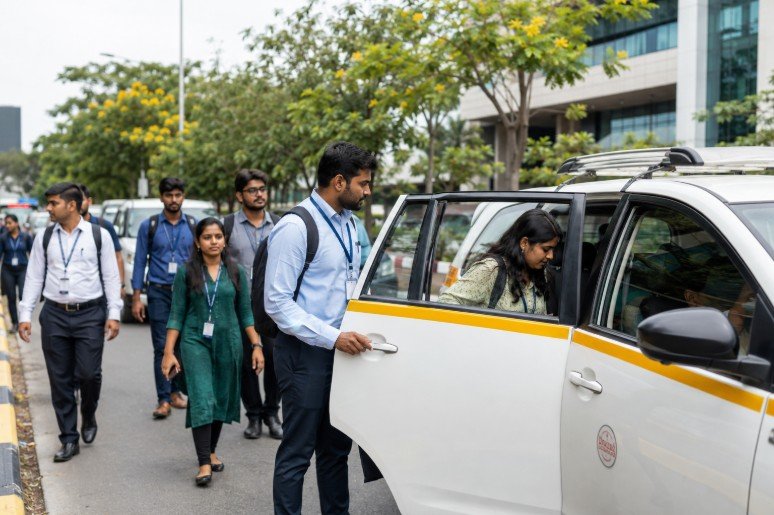
Not very long ago, a transport manager at a large technology company in Bengaluru mentioned something that caught everyone’s attention. Five years back, the company was running a smaller fleet and serving larger teams. Even then, complaints around delays and missed pickups were relatively limited. Today, with better approach to Employee Mobility and Route Optimization the transport team somehow finds itself under greater pressure.
On paper, that sounds backwards.
The explanation, however, was fairly straightforward once the operations team started digging deeper. Employees had moved homes. Hybrid work had changed attendance patterns. Traffic conditions had become increasingly erratic. Yet the route structure itself had hardly evolved. Nothing failed suddenly. That is rarely how transport operations work. Small inefficiencies had been accumulating over the years and, eventually, they began showing up in costs, service quality, and employee feedback.
Which explains why Employee Transportation Operations Management has moved into strategic conversations inside large enterprises. Once operations start supporting hundreds or thousands of employees, transport influences much more than daily commutes. Productivity gets affected. Fleet costs do too. Employee satisfaction and business continuity quietly enter the equation as well.
Why Route Optimization Has Become Critical for Indian Enterprises?
Anyone who has managed transport across Indian cities knows there is no universal playbook.
Bengaluru behaves one way. Mumbai has its own rhythm. Hyderabad brings a different set of constraints. Pune, Chennai, and Gurugram add complexities of their own. Traffic conditions shift throughout the day, employees relocate frequently, and attendance itself has become less predictable than it used to be.
Employees, meanwhile, expect reliability. Understandably so.
According to the TomTom Traffic Index, Bengaluru remains one of the most congested cities globally, with travel times continuing to rise.
Longer commutes affect more than fuel consumption. They influence punctuality, employee fatigue, and eventually overall productivity. A journey that consistently stretches beyond expectations has a way of showing up elsewhere. Managers notice it. Employees certainly do.
As organizations expand into multiple cities and continue adapting to hybrid work models, transport planning demands a different level of attention. Systems built around fixed schedules and a single office location simply struggle once complexity enters the picture.
Why Traditional Route Planning Starts Showing Its Age?
Many transport networks still rely on routes that were designed years ago. At the time, those plans probably made complete sense. Employee density looked different, attendance patterns were stable, and business requirements themselves were easier to forecast.
Things changed. The routes didn’t.
That gap creates problems.
Hybrid schedules, rotating shifts, and changing pickup locations have introduced a level of complexity that static route structures find difficult to absorb. Vehicle utilization starts slipping. Travel times begin inching upward. Fuel costs slowly follow the same direction. None of these developments feel alarming when viewed individually. Collectively, though, they tell a different story.
By the time complaints begin surfacing regularly, inefficiencies have usually been around for much longer.
Regular route reviews matter for precisely this reason. Waiting until problems become visible often means the organization has already absorbed months of avoidable expenses and operational friction.
Data Is Changing Transportation Operations Management
Transport teams today generate an astonishing amount of information. Occupancy levels, travel durations, route deviations, delays, idle hours, fuel consumption. The data exists.
Making sense of it, however, is where the challenge lies.
Modern Transportation Operations Management relies heavily on continuous analysis. Patterns matter. A vehicle that consistently operates below capacity deserves attention. Delays that occur every Monday morning are rarely random. Sometimes the answer requires a complete route redesign. Sometimes a slight adjustment in departure timings solves the issue. It looks simple on paper. It rarely is.
According to IMARC Group, India’s fleet management market is projected to grow from USD 1.3 billion in 2025 to more than USD 3 billion by 2034.
That growth says something about the direction enterprises are taking. Visibility and analytics are no longer viewed as nice additions. They have become operational necessities.
And frankly, decisions supported by data are easier to defend when leadership starts asking difficult questions.
Flexibility Has Become Part of the Job
Employee mobility today looks very different from what it did even five years ago.
Hybrid work changed things. Distributed teams added another layer. Rotational shifts complicated matters further. Demand patterns now fluctuate in ways that transport teams simply cannot ignore.
Routes that performed perfectly six months earlier may require adjustments today. There is nothing unusual about that.
Dynamic route planning helps organizations respond without creating disruption for employees. Vehicle allocation improves, idle capacity comes down, and service consistency becomes easier to maintain. Growth also becomes more manageable because the system evolves alongside the business instead of resisting change.
Operations rarely stay frozen for long. Transport frameworks shouldn’t either.
Technology Helps. Execution Still Matters More.
Technology has changed the way Employee Mobility & Route Optimization is managed. Dashboards provide visibility. GPS systems make tracking easier. Analytics platforms help identify patterns that would otherwise remain hidden.
Useful tools. Very useful, actually.
But tools have limitations.
Software cannot compensate for weak governance. A dashboard cannot replace vendor accountability. Escalation mechanisms still matter. Route reviews matter. Service standards matter too. Technology highlights problems. People and processes solve them.
The strongest transport operations usually rely on both.
That balance creates consistency, and consistency tends to matter more to employees than organizations sometimes realize. Employees may not praise a smooth commute every day, but they certainly notice when things stop working.
Planning for Scale Before Scale Arrives
Growth changes transport operations quickly. Sometimes faster than expected.
New offices open. Employee numbers increase. Work schedules evolve. Before long, systems designed around today’s requirements begin struggling under tomorrow’s realities.
Which is why scalability deserves attention early.
Flexible frameworks allow routes to be modified without causing widespread disruption. Vendors can be added. Operations can expand into new cities while maintaining service standards. Organizations that prepare in advance generally avoid large corrections later, and those corrections are rarely inexpensive.
Transport systems are expected to support growth. They should not become the reason growth becomes difficult.
Looking Ahead
Employee transport operations are becoming more demanding with every passing year. Expectations have changed. Traffic congestion continues to challenge planners. Hybrid work has introduced entirely new variables, and cost pressures remain very real.
What makes inefficiencies difficult to identify is that they do not arrive dramatically. A few routes become longer than they should be. Vehicle utilization starts slipping. Travel times increase gradually. Individually, these changes seem manageable. Together, they affect costs, employee experience, operational visibility, and overall service reliability in ways that are difficult to ignore.
And by the time leadership starts asking why transport expenses are rising, the underlying causes have often been present for quite some time.
Organizations that invest in stronger visibility, structured route planning, and intelligent mobility frameworks today will almost certainly find themselves in a better position tomorrow.
Looking to improve fleet efficiency and create a better experience for employees? Explore ConsultTrans’ approach to Employee Mobility and Route Optimization and discover how smarter route planning can deliver stronger cost control, greater operational visibility, improved scalability, and more dependable daily commutes across the organization.